
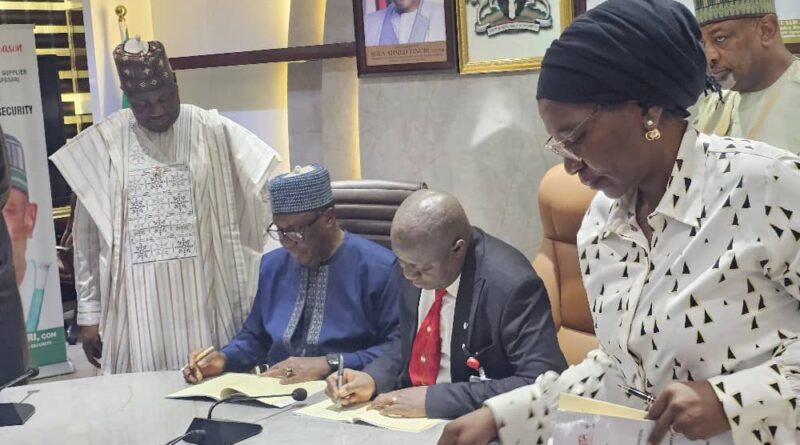
FG, IITA partner to drive soil health, enhance farm productivity nationwide
The Federal Ministry of Agriculture and Food Security (FMAFS) has signed a Memorandum of Understanding (MoU) with the International Institute of Tropical Agriculture (IITA) to strengthen soil health, improve fertiliser efficiency and raise farm productivity across Nigeria.
The agreement, signed in Abuja, supports the Nigeria Farmers Soil Health Scheme and the development of a national soil information system aimed at promoting sustainable and climate-resilient agriculture.
IITA Director-General, Dr Simeon Ehui, said the partnership builds on ongoing efforts to expand precise soil testing and crop-specific fertiliser recommendations nationwide. He noted that the MoU addresses persistent soil fertility challenges through data-driven tools, advanced technologies and regional expertise.
According to Ehui, implementation will be coordinated through the Regional Hub for Fertiliser and Soil Health for West Africa and the Sahel, hosted by IITA, which will serve as a technical backbone for soil health initiatives in the sub-region. He added that the scheme elevates soil health to a national priority and will stimulate demand for digital soil maps, fertiliser recommendations and improved laboratory standards.
Minister of Agriculture and Food Security, Sen. Abubakar Kyari, described healthy soil as fundamental to improved productivity and nutritious food systems, assuring that the ministry would ensure full implementation of the MoU within agreed timelines.
Minister of State for Agriculture and Food Security, Sen. Aliyu Abdullahi, said the agreement formalises collaboration between both institutions, enabling joint studies, strengthened land management and enhanced climate services. He noted that while agriculture employs more than 70 per cent of Nigeria’s workforce, soil degradation, erosion and climate impacts continue to threaten food security and livelihoods.
Abdullahi said the partnership with IITA marks a critical step towards science-based and sustainable solutions, adding that farmers would be equipped with the knowledge and resources needed to optimise fertiliser use, improve soil health and increase productivity.
The MoU is seen as a significant milestone in Nigeria’s drive towards sustainable agriculture, food security and climate resilience.