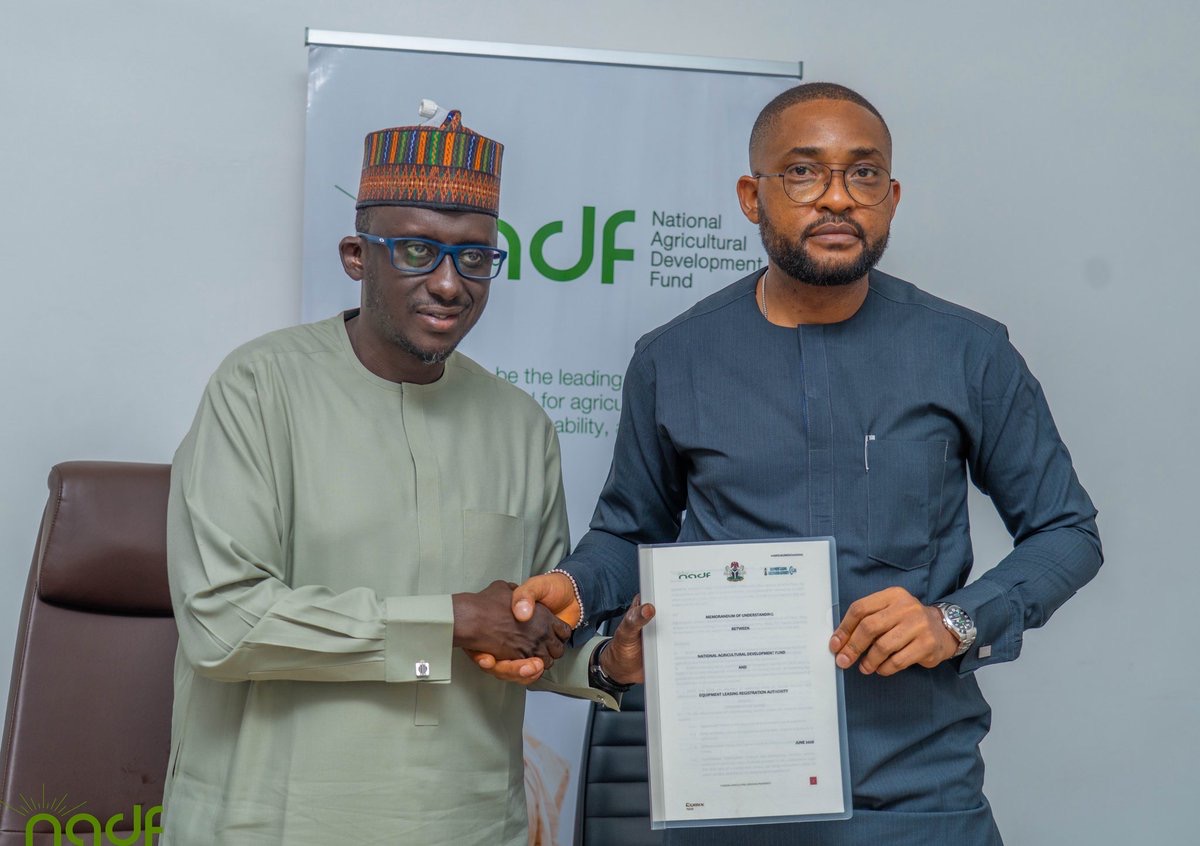
ELRA and NADF Sign MoU to Expand Tractor Leasing for Farmers
Samuel Kehinde
The Equipment Leasing Registration Authority and the National Agricultural Development Fund signed an agreement in Abuja to expand farmers’ access to tractors, harvesters, and irrigation systems through finance leases, lease-to-own schemes, and operating leases. The partnership is aimed at solving the financing constraints that keep most smallholder farmers from mechanisation.
Under the MoU, ELRA will provide the regulatory framework and registration of lease agreements, while NADF will work with commercial banks, microfinance institutions, and private leasing companies to unlock equipment financing. Farmers will not need to buy tractors outright. Instead, they can access machinery through three channels. Finance leases allow cooperatives to use tractors for several seasons with an option to buy at the end. Lease-to-own arrangements spread payment over harvest cycles, with ownership transferring after the final instalment. Operating leases cover short-term needs like land preparation or harvest, where farmers pay only for the period of use.
The model targets the core barrier in Okunland and across Nigeria: high upfront costs. A new 75hp tractor can cost ₦25 million to ₦35 million, which is out of reach for most farmers
Leasing breaks that cost into manageable payments tied to farm revenue.
NADF said the first phase will prioritise tractors, ploughs, harrows, planters, boom sprayers, combine harvesters, and solar-powered irrigation pumps. These are the tools most requested by grain, tuber, and vegetable farmers. The scheme will run through accredited vendors and leasing companies registered with ELRA, to ensure transparency and reduce disputes over asset repossession.
To qualify, farmers are expected to operate through registered cooperatives or clusters with at least 10 hectares of aggregated land. ELRA will maintain a central registry of all lease agreements, giving banks and vendors confidence to release equipment without demanding land as collateral.
For communities in Kabba, Isanlu, Egbe, and Mopa, the MoU opens a practical route to mechanisation if state and LGA structures move quickly. The Kogi Ministry of Agriculture and ADP offices will likely serve as enrolment points for cluster formation and equipment demand collation. Youth groups can also register as service providers, taking leases on tractors and offering land preparation services to smallholders on a pay-per-acre basis.
The real test will be last-mile delivery. Insecurity on farm roads and multiple levies have discouraged private tractor operators in recent seasons. ELRA and NADF will work through identifiable clusters with bank accounts, farm records, and a repayment plan. Cooperatives should begin mapping total hectares, crop type, and peak seasons for tillage and harvest. LGA agriculture desks should start compiling demand lists to submit when NADF opens the application window.
If implemented as designed, the lease model could reduce land preparation costs, cut post-harvest losses, and raise yields across staple crops. The difference between an MoU and real impact will be how fast equipment reaches farmers before the next planting season.